Grupo Siroco
Your Boat Expert
Choose from our exclusive brands: Lagoon, Jeanneau, and Excess.
Browse through the thousands of boating products we have for you.
A professional technical team dedicated to ensuring that you always sail safely.
Sign up for our exclusive events and stay up to date on the latest news in the boating world.
Tips
What you can do on your own and what you should leave to the repair shop.
Grupo Siroco
Your Boat Expert
How your boat spends the winter determines the condition you’ll find it in come spring. An idle engine with used oil, dead batteries, or damp sails rarely show any signs of trouble in December. They become apparent in April, on your first outing.
In Portugal, winter storage doesn’t necessarily mean coming to a complete stop. Many owners continue to sail on nice winter days. Even so, there are systems that need attention when use slows down.
In this guide, we’ve broken it down system by system, explaining what you can do yourself and what we recommend leaving to a professional. Not to complicate routine maintenance, but to ensure each task is handled by the right people.
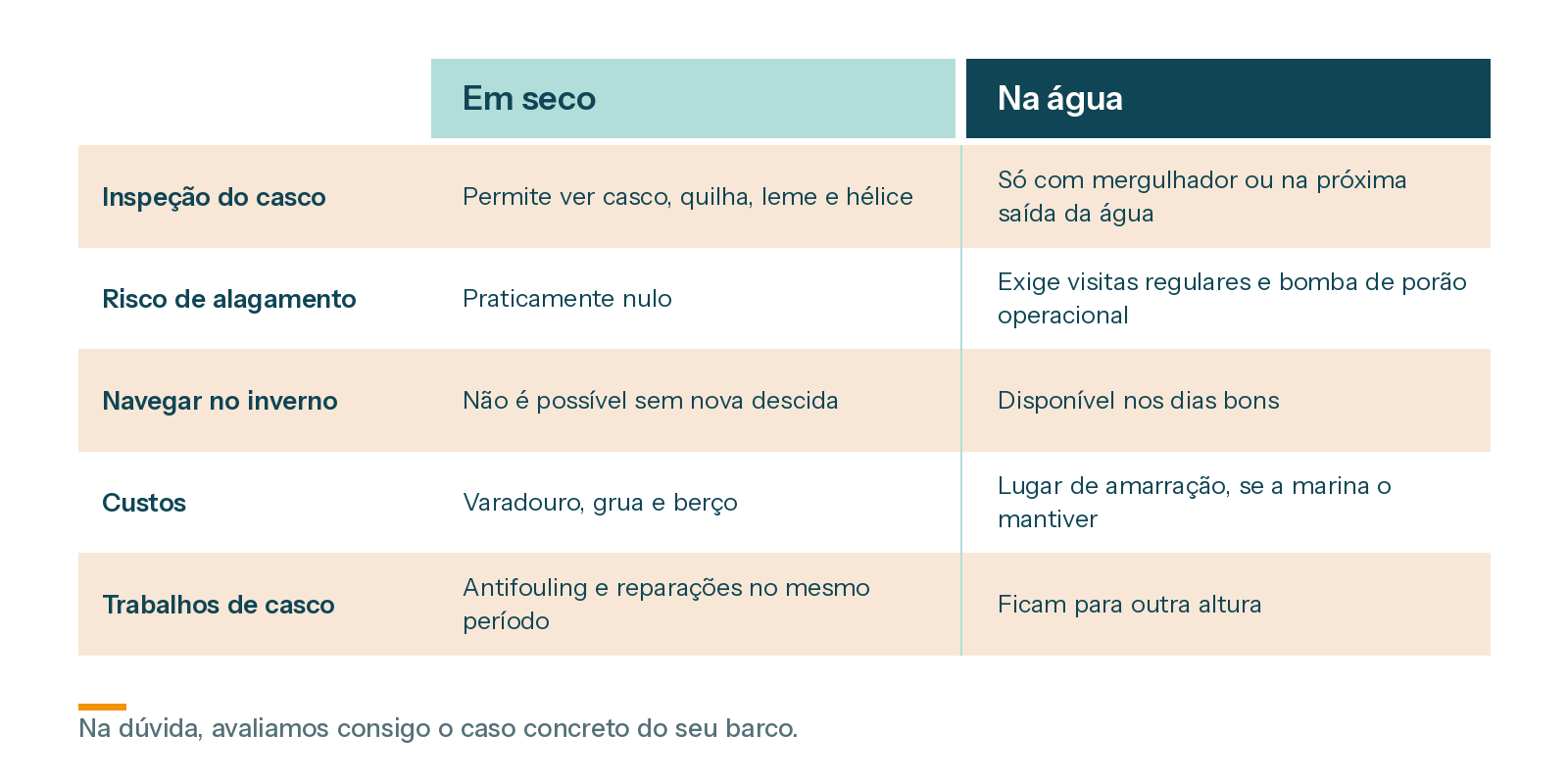
There is no single answer. The choice depends on how much you'll use the boat, the condition of the hull, and the marina where it's docked.
If the antifouling is nearing the end of its useful life or if you have concerns about the hull, taking the boat out of the water is usually worth it. If you plan to sail during the winter and visit the boat frequently, leaving it in the water may make sense. If you’re unsure, talk to us: we’ll assess your specific situation with you.
Used oil contains acidic residues that can damage the engine during months of inactivity. That’s why you should change the oil before winter, not after.
You can do it yourself
• Fill the fuel tank to minimize the space where condensation can form, and add a diesel fuel stabilizer.
• Check the fuel filter’s water separator and drain any accumulated water.
• For an outboard motor: flush the cooling system with fresh water and store it upright, with no fuel in the carburetor.
• Clean the engine compartment and check for oil, fuel, or water leaks.
We recommend taking it to a repair shop
• Change the oil and replace the oil and fuel filters, and record this in the maintenance log.
• Replacement of the seawater pump impeller and inspection of the heat exchanger and its anodes.
• Flush the seawater circuit with fresh water and, in areas at risk of freezing, protect it with antifreeze.
• For sail drive transmissions: oil, condition of the diaphragm and anode, according to the manufacturer’s intervals.
• Check the belts, engine mounts, and shaft alignment.
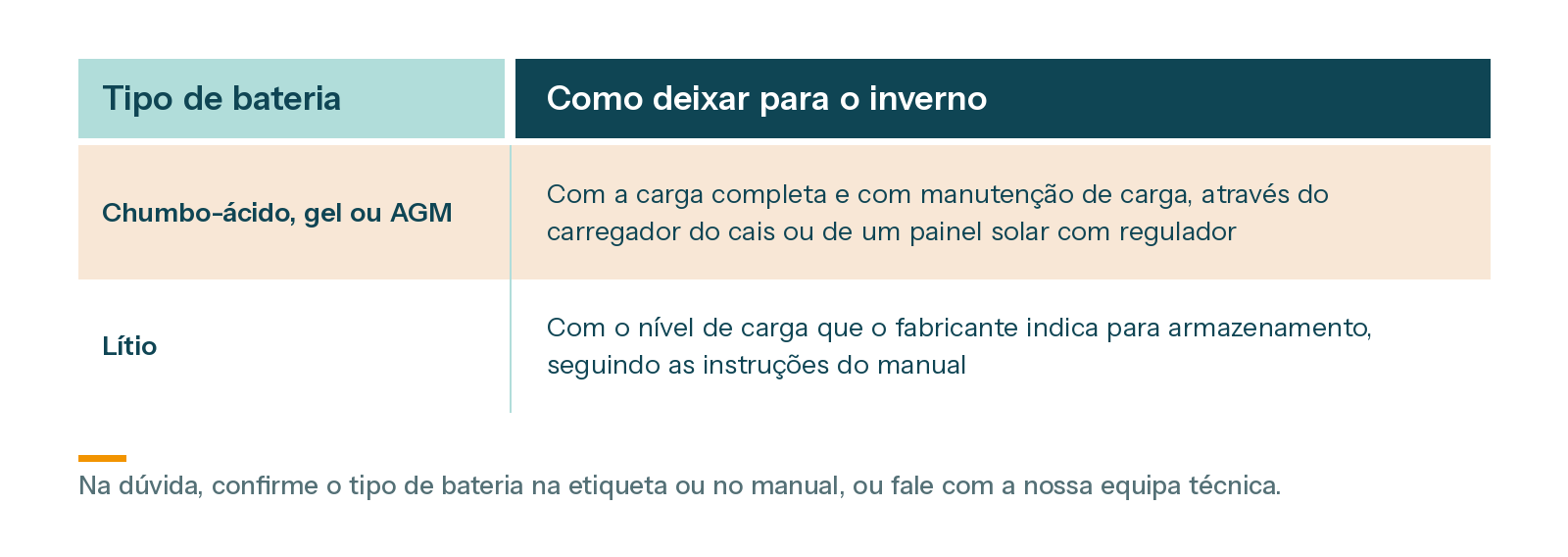
Batteries are among the first components to suffer when a vehicle isn’t properly prepared for winter. But the right care depends on the type of battery: what protects a lead-acid battery can shorten the life of a lithium battery. Therefore, the first step is to check what type of batteries you have on board—either on the label or in the manual.
A lead-acid battery that remains discharged for months loses capacity permanently and may not recover.
You can do this yourself
Important note if the boat is in the water: when disconnecting the batteries, do not cut off the circuit that powers the automatic bilge pump. Make sure the pump has a constant power supply and test it by lifting the float.
We recommend taking it to a repair shop
• Battery capacity test, to determine whether they’ll last until next season or if they should be replaced now.
• Check the settings of the onboard charger, solar regulator, and inverter to ensure they are configured for the type of battery installed, especially if lead-acid batteries have been replaced with lithium batteries.
• Inspect the electrical panel, connections, and cables for signs of overheating or corrosion.
• Diagnose current leaks, which accelerate corrosion of the anodes and other submerged metal parts.
The bottom valves are the spot where even a small leak can sink a moored boat. They deserve attention, whether the boat is on dry land or in the water.
You can do this yourself
• Open and close all bilge valves to make sure they aren’t stuck, and leave closed any that don’t need to be open.
• Check the clamps on the hoses connected to the valves.
• If the boat is out of the water: wash the hull as soon as it comes out of the water, before any residue dries, and look for bubbles, cracks, or areas of damaged gelcoat.
• Make sure the bilge pump and its circuit breaker are working.
We recommend the following maintenance:
• Inspect the anodes and replace them when they are severely worn.
• Measure the hull’s moisture content if osmosis is suspected.
• Check the play in the rudder, the bushings, and the rudder stock.
• Inspect the keel and its mountings, especially on sailboats that have grounded during the season.
• Preparation and application of antifouling paint, if the boat will be stored out of the water.
Salt and moisture cause more damage to the sailcloth during months of inactivity than during an entire sailing season. Removing and storing the sails properly is the best protection you can give them.
You can do this yourself
• Take down the sails, wash them with fresh water, let them dry completely, and store them folded in a dry place off the boat.
• Check the seams, reinforcements, and the UV-protective strip on the furled genoa.
• Wash the control lines with fresh water and replace any that are worn or stiff.
• Disassemble, clean, and lubricate the winches with the appropriate product.
We recommend the workshop
• Rig inspection: terminals, splices, turnbuckles, and pins, where cracks may initially be invisible to the naked eye.
• Inspection of the mast, spreader, furler, and their respective bearings.
• Assess the age of the rigging in accordance with the manufacturer’s and insurance company’s recommendations.
• Repairs to the sails identified during the inspection.
A closed boat with no ventilation traps moisture, and moisture leads to mold, odors, and corrosion of electrical connections. Letting air circulate is more important than keeping everything closed up.
You can do this yourself
• Remove pillows, mattresses, bedding, and textiles—or at least lift them up to allow air to circulate.
• Leave cabinets, drawers, storage compartments, and the refrigerator open, clean, and dry.
• Place moisture absorbers or a dehumidifier, if there is power on board.
• Empty and clean the hold so it stays dry.
• Empty the fresh water tanks and open the faucets to drain the system. Before draining the water heater, disconnect it from the power supply: draining it while it’s still connected can burn out the heating element. If you’re unsure how to do this on your boat, ask our technical team.
• Flush the toilet system with fresh water and empty the black water tank.
We recommend the workshop
• Disinfect the fresh water system before refilling it in the spring.
• Check the pressure pump, the water heater, and, if present, the watermaker, which has its own shutdown procedure.
• Inspect hatches and portholes for leaks.
After more than three decades of providing technical assistance, there are certain situations that our team sees recurring when the boats are being prepared for the season.
1. Sails stored while damp. Mold sets in on the fabric and, in many cases, won’t come out.
2. Forgotten batteries. A battery that has been discharged for months rarely regains its original capacity.
3. Oil changed only in the spring. The engine spends the winter in contact with residues from the used oil.
4. Boat sealed airtight. Without ventilation, the interior develops mold and odors that are difficult to eliminate.
5. Loose covers. A cover that flaps in the wind scratches the gelcoat and wears itself out.
6. Boat left in the water without regular checks. A leaking hose or a failing bilge pump is often discovered too late.
Almost all of these problems can be prevented with just one or two hours of work at the start of winter.
Many of the tasks in this guide are within the reach of any boat owner. Others require tools, parts, and expertise that make a visit to the repair shop worthwhile. The important thing is that none of them go undone.
Grupo Siroco’s technical team oversees the winterization of boats of all makes, whether purchased from us or not. We perform a diagnostic check, explain what we’ve found, and proceed only with what’s necessary. The workshop’s winter schedule is organized on a first-come, first-served basis.
Schedule a Winterization Service
For tasks you can do yourself, boat covers, trickle chargers, moisture absorbers, and winch lubricants are available at our marine store.
Subscribe to our newsletter
If you don't have an account yet, you can create one now.
On November 13 and 14, 2026, Jeanneau will open the doors of its factory in Cholet, France, for the Jeanneau Private Days, an exclusive event that invites boating enthusiasts to get an up-close look at the craftsmanship, experience, and innovation that set the brand apart.