Grupo Siroco
Your Boat Expert
Choose from our exclusive brands: Lagoon, Jeanneau, and Excess.
Browse through the thousands of boating products we have for you.
A professional technical team dedicated to ensuring that you always sail safely.
Sign up for our exclusive events and stay up to date on the latest news in the boating world.
Choose from our exclusive brands: Lagoon, Jeanneau, and Excess.
Browse through the thousands of boating products we have for you.
A professional technical team dedicated to ensuring that you always sail safely.
Sign up for our exclusive events and stay up to date on the latest news in the boating world.
Tips
How do they work, and how much energy do they need?
Grupo Siroco
Your Boat Expert
Having power available on board is one of the biggest concerns for anyone who spends several days at sea. Refrigerators, lighting, navigation instruments, autopilots, chargers, pumps, and other equipment are all part of modern life on board, and they all depend on the same thing: power.
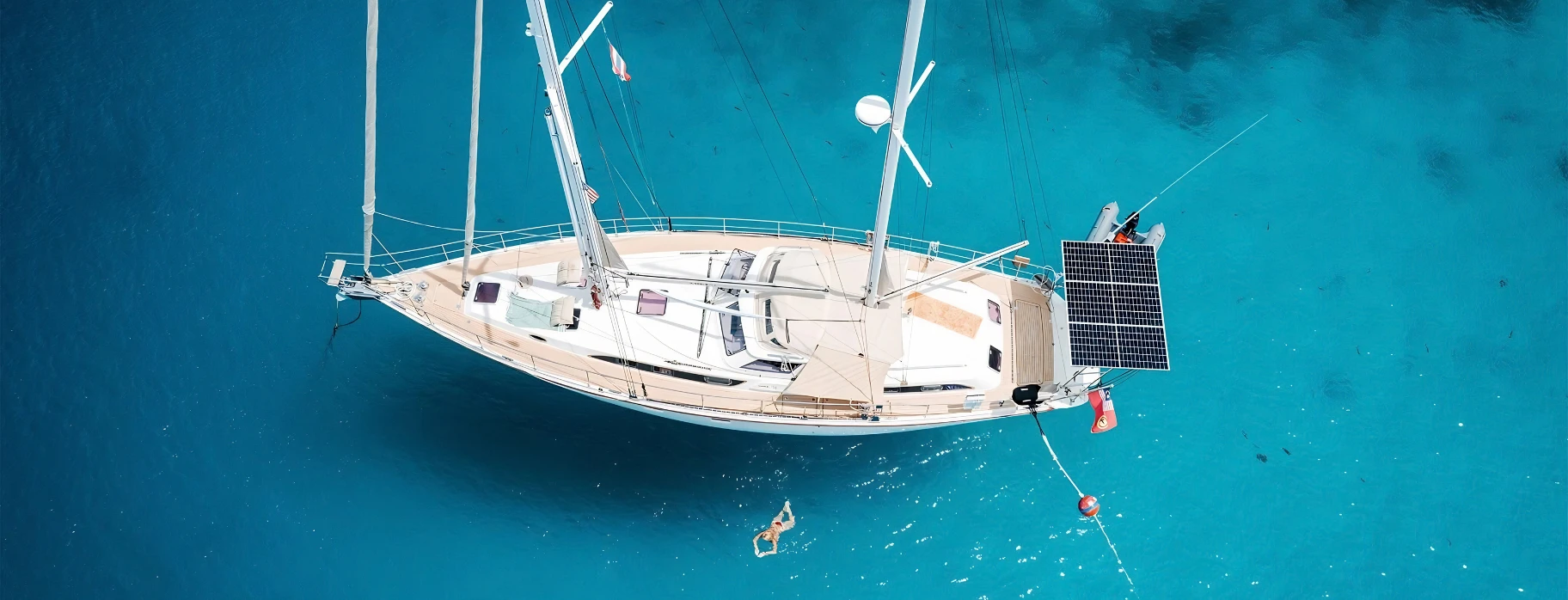
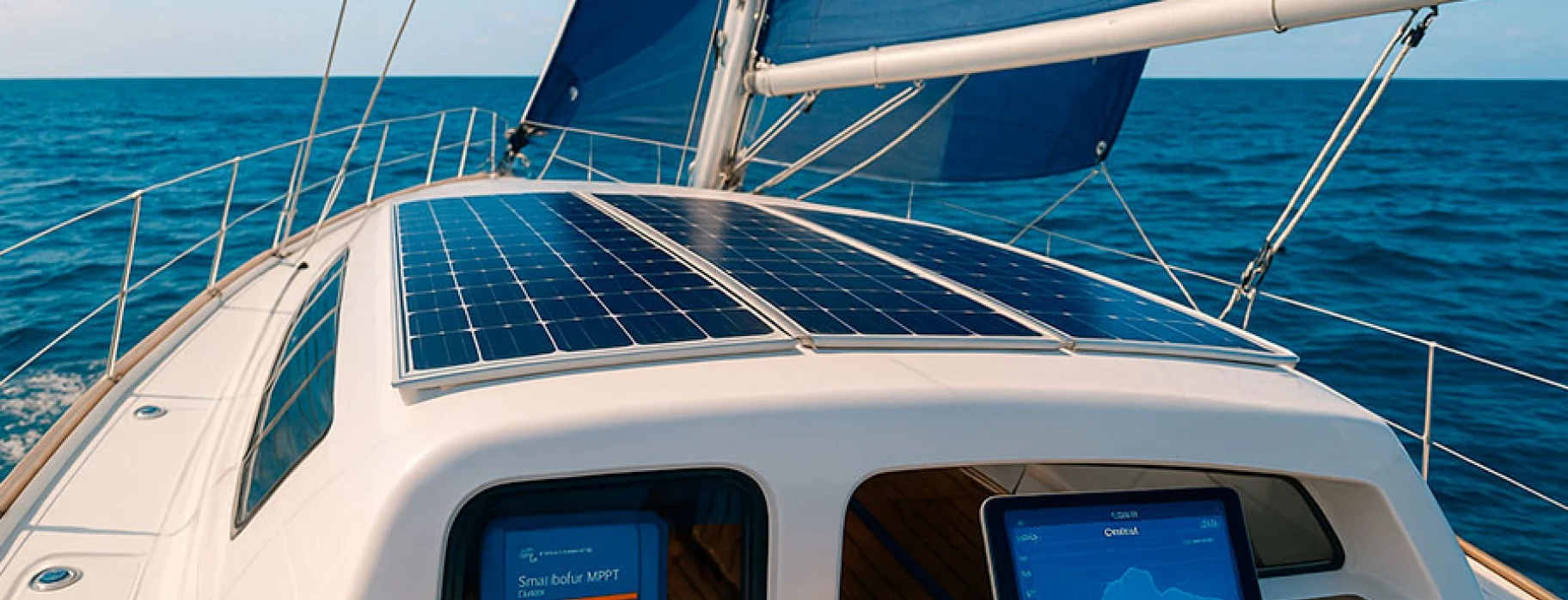
This is where solar panels for boats have taken on an increasingly important role. They don’t necessarily replace all other energy sources, but they can significantly reduce the need to run the engine or generator and increase the boat’s range.
But how much energy are we really talking about? And how do you know how many solar panels you need?
When we’re at a marina, hooking up the boat to the power supply is simple. The situation changes completely when we spend several days at anchor or sailing far from shore.
Solar power has a major advantage: it generates electricity while the boat is stationary, underway, or at anchor, without requiring fuel and with virtually no crew intervention.
For those who enjoy spending time on board, this autonomy can make a huge difference. Instead of starting the engine just to charge the batteries, you can use some of the energy produced during the day to power your equipment and recharge the batteries.
The amount of energy produced depends, of course, on several factors: the panels’ power output, hours of sunlight, orientation, shadows, and the system’s efficiency.
Therefore, installing “the largest panel possible” isn’t always the best solution. The first step is to figure out how much power the boat actually consumes.
Before choosing solar panels, it’s a good idea to make a short list of all the electrical equipment used on board.
A refrigerator can run for many hours a day. The autopilot can account for a significant amount of power consumption during a long voyage. Chartplotters, AIS, instruments, lighting, pumps, cell phone chargers, and computers all add to the power consumption.
The best way to start is to calculate daily power consumption.
For example, if a device draws 5 amps and is on for 4 hours, it will have consumed approximately 20 Ah. By repeating this calculation for the remaining devices, we can obtain an estimate of the boat’s daily power consumption.
It’s also important to distinguish between battery consumption and battery capacity. Having high-capacity batteries allows you to store more energy, but it doesn’t mean the boat produces more energy.
The system should be viewed as a whole: solar production + batteries + consumption.
Once we know the daily consumption, we can determine the required production capacity.
Imagine a boat that consumes, on average, 1,500 Wh per day. If the panels can produce an effective average of 4 hours of usable power per day, about 375 W of solar power would be needed to offset that average consumption.
In reality, the calculation is never that straightforward. Production varies with the season, location, panel orientation, temperature, and shading.
On a boat, shading is particularly important. A mast, a sail, a radar, or other equipment can significantly reduce the output of a partially shaded panel.
That is why the location and configuration of the panels are just as important as the installed capacity.
On many boats, it may be beneficial to combine different panels and use appropriate controllers to make better use of the available energy.
Solar power isn’t just about reducing fuel consumption. Above all, it’s about gaining freedom.
Being able to stay anchored for several days without having to pull into a marina or regularly start the engine changes the whole boating experience. For those who go cruising, this autonomy can be particularly important.
Before installing a solar system, it’s worth analyzing the boat’s actual energy consumption, battery capacity, available space, and how the vessel is used.
A properly sized system doesn’t simply mean installing more panels. It means finding the right balance between production, storage, and consumption, taking into account how the boat is actually used.
Ultimately, the best question isn’t “How many panels can I install?” but rather, “How much autonomy do I want to have on board?”
Subscribe to our newsletter
Tips
Tips
Tips
Tips
Tips
Tips